
Last Updated: November 14, 2026
Quick Summary
To calculate wet food feeding, find your cat's daily calorie target using ideal weight times roughly 20 calories per pound, then divide that by the calories per can listed on the label. A 10-pound indoor cat needing about 200 calories, for example, gets roughly 2.5 to 3 cans of a 75-calorie food daily, split across meals.
- Estimate daily calories as ideal weight in pounds multiplied by about 20 for a typical indoor adult cat.
- Calorie density varies between brands, so two same-size cans can differ by 50 calories or more.
- For mixed feeding, subtract wet calories from the daily target to find the dry allowance.
- Feed adult cats wet food twice daily, or three to four smaller meals if they gulp or beg.
- Weigh your cat every two to four weeks and adjust the ration by about 10 percent if weight drifts.
Table of Contents
- Start With Calories, Not Cans: The Wet Food Feeding Formula
- How Much Wet Food to Feed a Cat Chart by Weight and Activity Level
- How Much Wet Food to Feed a Cat Calculator: Doing the Math in Seconds
- How Much Wet Food and Dry Food to Feed a Cat Per Day
- How Many Times Should I Feed My Cat Wet Food Per Day?
- Kittens, Seniors, and Cats With Weight Goals: Adjusting the Daily Ration
- Monitoring, Storing, and Adjusting Portions Over Time
- Weigh Your Cat's Next Meal With a Precision Feeding Tool
- Frequently Asked Questions
Start With Calories, Not Cans: The Wet Food Feeding Formula
Most cat owners guess. They scoop half a can, hope for the best, and wonder why their cat is gaining weight or begging for more an hour later. The fix for how much wet food to feed a cat daily starts with one number: calories.
The answer is simpler than most guides suggest: find your cat's calorie target, read the label, divide.
Here's the three-step method we recommend.
Step 1: Find Your Cat's Ideal Weight and Daily Calorie Target
Start with your cat's ideal weight, not current weight if they're carrying extra pounds. Your vet can confirm this at a checkup.
Once you have ideal weight, estimate calories using a standard resting energy formula. Many vets use roughly 20 calories per pound of ideal body weight for a typical indoor adult cat.
This is an estimate, not gospel. Your vet can fine-tune it based on metabolism and activity level.
Step 2: Read the Food Label for Calories per Can or Pouch
Every complete and balanced wet cat food states calorie content on the label. Look for the kcal per can, pouch, or kilogram. A 3-ounce can might list its calories per can, while a 5.5-ounce can lists a different total.
Write that number down. This calorie density figure makes the whole calculation work. Ignore the back-of-label feeding guidelines for now, they're for an average cat, not yours.
Step 3: Divide Calories by Calories per Can to Get the Daily Ration
Now do the math. Divide your cat's daily calorie target by the calories per can.
Say your cat needs 200 calories daily and the food has 80 calories per 3-ounce can. That's 2.5 cans daily, split across meals.
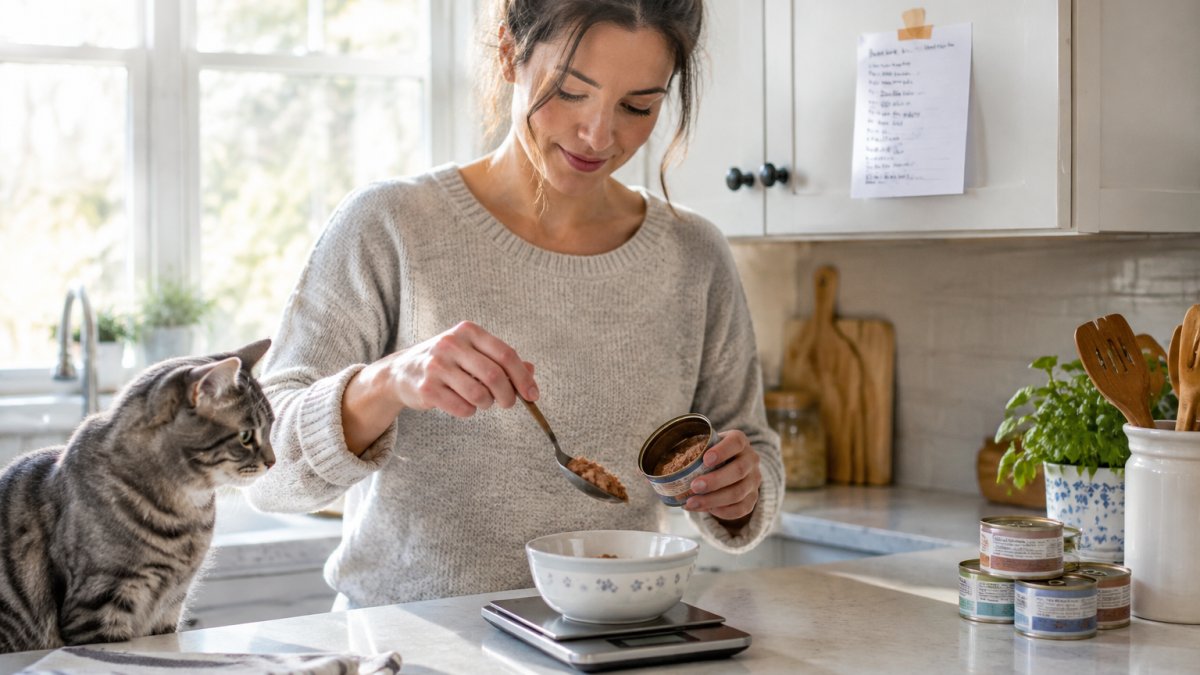
That's your daily ration. Weigh it, don't guess it. A kitchen scale or digital measuring spoon keeps portions consistent day to day, which matters more than most people realize.
How Much Wet Food to Feed a Cat Chart by Weight and Activity Level
Charts are a starting point, not a final answer. Use this table as a quick reference, then confirm with the calorie math above. These figures assume an average calorie density of about 25 to 30 calories per ounce of wet food, which covers most standard cans and pouches.
| Cat's Ideal Weight | Activity Level | Daily Calories (estimate) | Wet Food Per Day (approx.) |
|---|---|---|---|
| 6 lb | Low | 120 | 4 to 5 oz |
| 8 lb | Low | 160 | 5.5 to 6.5 oz |
| 8 lb | Active | 200 | 7 to 8 oz |
| 10 lb | Low | 200 | 7 to 8 oz |
| 10 lb | Active | 240 | 8 to 9.5 oz |
| 12 lb | Low | 240 | 8 to 9.5 oz |
| 12 lb | Active | 290 | 10 to 11.5 oz |
| 15 lb | Low | 300 | 10 to 12 oz |
Two notes: these are estimates, and every cat is different. If your cat is overweight, feed toward ideal weight, not current weight, and let your vet guide any weight loss plan.
How Much Wet Food to Feed a Cat Calculator: Doing the Math in Seconds
You don't need a special app. The wet food feeding calculation fits on a sticky note.
The formula: ideal weight in pounds × 20 = daily calories. Then daily calories ÷ calories per can = cans per day.
Worked example: a 10-pound indoor cat needs about 200 calories. The label says 75 calories per 3-ounce can.
A few practical notes:
- Calorie density varies wildly between brands. Two same-size cans can differ by 50 calories or more.
- Pâté styles tend to pack more calories per ounce than flaked or shredded textures in gravy.
- Weigh the food, not the can. Half a can poured by eye is rarely half a can.
If math isn't your thing, a digital scale takes the guesswork out.
How Much Wet Food and Dry Food to Feed a Cat Per Day
Mixed feeding is where most people get confused. You're not adding a full wet ration on top of a full dry ration. You're splitting one calorie budget between the two foods. The method below is the one most practitioners use because it prevents the most common error: treating wet food as a bonus on top of a full bowl of dry.
The Subtraction Method, Step by Step
- Set the daily calorie target. Use ideal weight and the resting energy estimate, then confirm with your vet. Example: a 10-pound indoor adult cat needs about 200 calories daily.
- Decide the wet share. Many cat parents aim for roughly half, but the split is personal. Write down the percentage so you can repeat it.
- Convert the wet share to cans. Divide wet calories by calories per can or pouch. At 75 calories per 3-ounce can, 100 wet calories is about 1.3 cans daily.
- Subtract to find the dry allowance. Daily calories minus wet calories equals dry-food calories left. Here, 200 minus 100 leaves 100 calories for dry.
- Convert the dry allowance to cups or grams. Divide remaining calories by the dry food's calories per cup or per gram. At 350 calories per cup, 100 calories is about 0.3 cups, or a scant third of a cup. If the label lists calories per kilogram, divide by 1,000 to get calories per gram, then weigh the portion.
- Split both foods across meals. Feed wet at set meal times and measure dry into a separate bowl or use it as a snack. Do not top off the dry bowl freely.
A Second Worked Example With a Different Split
A 12-pound active cat needs about 290 calories daily. You want 60 percent from wet and 40 percent from dry.
- Wet: 60 percent of 290 is about 174 calories. At 90 calories per 5.5-ounce can, that's roughly 1.9 cans daily.
- Dry: 40 percent of 290 is about 116 calories. At 400 calories per cup, that's about 0.29 cups, or a little over a quarter cup.
Total for the day: about 1.9 cans of wet plus a quarter cup of dry. Nothing else except water.
Why the Subtraction Step Matters
Dry food is calorie-dense, so small extras add up fast.
Watch out: the most common mixed-feeding mistake is measuring the wet portion carefully and then free-feeding dry food. That silently doubles the calorie budget.
If your cat is overweight, do the same math using ideal weight, not current weight, and have your veterinarian confirm the calorie target before you start.
How Many Times Should I Feed My Cat Wet Food Per Day?
Twice daily is the standard answer for adult cats, split into morning and evening meals. Some cats do better with three or four smaller meals, especially if they gulp their food or beg between meals.
Cats are natural grazers, built for several small meals rather than one big one. We cover how to choose one in our guide on picking an automatic cat feeder with portion control.
A few feeding schedule tips:
- Keep meals at consistent times. Cats thrive on routine.
- Pick up uneaten wet food after about 30 minutes. It spoils fast at room temperature.
- If you feed twice daily, split the ration evenly unless your vet says otherwise.
Kittens, Seniors, and Cats With Weight Goals: Adjusting the Daily Ration
Life stage changes the math. A kitten is not a small adult cat, and a senior cat is not a middle-aged one.
Kittens need far more calories per pound because they're growing, and do better with three to four meals daily. Wet food suits kittens since it's easy to eat and adds moisture. Ask your vet for a calorie target based on age and growth rate.
Senior cats often need fewer calories as metabolism slows, but may lose appetite or struggle to chew.
Cats with weight goals need a vet-guided plan. Feed toward ideal weight, measure every meal, and recheck body condition monthly.
Cats with medical conditions like kidney disease or diabetes need a vet-designed feeding plan.
Monitoring, Storing, and Adjusting Portions Over Time
A feeding plan is a living thing. Your cat's needs shift with age, activity, and season, and the only way to know whether the daily ration is right is to measure the result. This section gives you a schedule and a rule for changing portions, plus the storage and serving practices that keep wet food safe.
A Simple Weigh-In and Adjustment Schedule
Weigh your cat on a baby or pet scale every two to four weeks, at the same time of day, ideally before a meal. Record the number. A kitchen scale works for small cats and kittens if the platform is stable.
Use this rule of thumb for adjustments:
- Steady weight and good body condition: keep the current ration.
- Weight drifting up over two consecutive weigh-ins: reduce the daily ration by about 10 percent, then recheck in two to four weeks. Cut from treats and dry food first.
- Weight drifting down over two consecutive weigh-ins: increase the daily ration by about 10 percent and recheck. If the drop continues despite more food, call your vet.
For cats on a weight-loss plan, your veterinarian sets the target rate. A common veterinary guideline is roughly 0.5 to 1 percent of body weight per week, but the exact pace should come from your vet. Never crash-diet a cat.
Signs the Portion Is Too High or Too Low
Watch for these signals between weigh-ins:
- Weight creeping up or down over a month
- Increased begging, food guarding, or scavenging
- Eating too fast, which can lead to vomiting or choking
If your cat eats too fast when portions change, our guide on how to stop your cat from eating too fast covers mealtime fixes that pair well with portion adjustments.
Storing and Serving Wet Food Safely
Wet food spoils faster than dry, so storage and serving habits matter as much as the portion size.
- Refrigerate opened cans promptly. Cover or transfer leftovers to a lidded container and refrigerate within about 30 minutes of opening. Use opened wet food within one to two days; check the label for the manufacturer's guidance.
- Serve at room temperature or slightly warm. Cats often reject cold food straight from the fridge. Let it sit out briefly or add a spoonful of warm water, which also adds moisture.
- Pick up uneaten wet food after about 30 minutes. Discard what the cat leaves rather than saving it for the next meal.
Watch out: a can that has been left out overnight or a pouch that sat in a hot car should be thrown away, not served. When in doubt, discard it.
When to Stop Adjusting and Call Your Vet
Sudden appetite changes, unexplained weight loss or gain, vomiting, diarrhea, or a cat that stops eating for more than a day are reasons to call your vet rather than adjust portions yourself. Pregnant and nursing cats, kittens, and cats on prescription diets also need a veterinary plan, because their calorie needs and food choices differ from a typical adult maintenance diet.
Weigh Your Cat's Next Meal With a Precision Feeding Tool
Guessing is the enemy of good feeding.
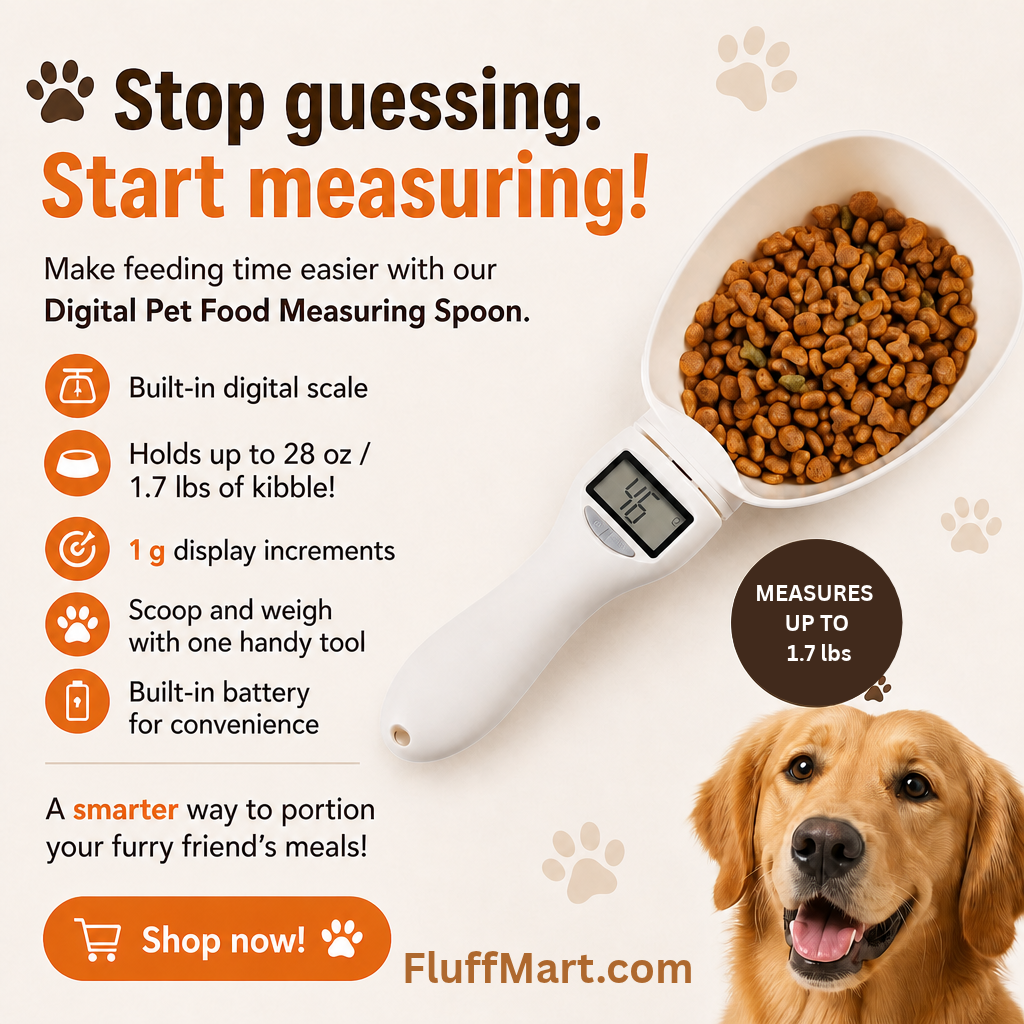
The Digital Pet Food Measuring Spoon from Fluff Mart combines scooping and weighing in one tool.
Key features for wet food portioning:
- Weigh food to the gram so every meal matches your plan
- Built-in battery, so no separate battery purchase is needed
- Compact spoon size of approximately 9 x 5.5 cm
Consistency matters. Consistent food portions can help you follow your pet's feeding recommendations and manage daily food intake more effectively.
Feeding your cat well doesn't have to be complicated, but it does take a number and a plan.
Frequently Asked Questions
How many cans of wet food should a cat eat daily?
It depends on the can size and calorie density. A typical 3-ounce can holds roughly 70 to 90 calories, while a 5.5-ounce can holds about 130 to 170 calories. An average 10-pound adult cat needs around 200 to 250 calories per day, which works out to about three 3-ounce cans or one and a half 5.5-ounce cans. Always check the label on your specific food, since calorie counts vary widely between brands and formulas.
Can you overfeed a cat with wet food?
Yes. Wet food is lower in calories per ounce than dry food, but a cat can still take in too many calories and gain weight. Overfeeding wet food also risks digestive upset and, in some cats, loose stools. Measure the daily ration with a scale or measuring spoon rather than free-feeding from the can, and track your cat's body condition score every few weeks so you can adjust portions before weight creeps up.
Should I follow the feeding chart on the cat food can?
Use it as a starting point, not a rule. Can feeding charts are built around broad weight ranges and often assume higher activity than an indoor cat actually gets, so many cats need less than the chart suggests. Start with the chart amount, then adjust based on your cat's body condition score, energy level, and weight trend over four to six weeks. Your veterinarian can give you a more precise calorie target for your cat's individual needs.
How do I switch my cat from dry food to wet food without stomach upset?
Transition gradually over seven to ten days. Mix a small amount of wet food into the dry, increasing the wet portion every few days while reducing the dry. Sudden switches can cause vomiting or diarrhea. Warm the wet food slightly to boost aroma for picky eaters, and feed at consistent times. If your cat refuses wet food entirely, try different textures, pates versus shreds, or a shallow bowl, and give each new food a few days before deciding it does not work.
