

Last Updated: November 2, 2026
Quick Summary
Choose an automatic cat feeder with portion control by matching its dispensing mechanism to your cat's kibble and its programming to your schedule, then checking serving increment, kibble compatibility, hopper capacity, power backup, and app control. Calibrate it with a 1-gram scale before trusting it unattended.
- Portion accuracy means each cycle hits your programmed amount, not that servings are small.
- Run five consecutive test cycles and weigh each portion to check average and spread.
- Re-calibrate after every food switch, refill habit change, or firmware update.
- Test battery backup by unplugging the unit mid-schedule and confirming the next meal dispenses.
- Microchip feeders only work if the reader reliably identifies each registered cat.
Table of Contents
- What Portion Control Actually Means in an Automatic Cat Feeder
- The Best Automatic Cat Feeder With Portion Control: What to Compare Before You Buy
- Meal Scheduling, Feeding Frequency, and Food Capacity
- Automatic Cat Feeder for Multiple Cats: Access Control and Household Logistics
- Automatic Cat Feeder for Wet Food: What Actually Works
- Automatic Cat Feeder With Refrigerated Wet Food: Cooling, Cost, and Trade-offs
- Calibrating Portions and Planning for Failures
- Setting Up Your Precision Feeding Routine With Fluff Mart
- Frequently Asked Questions
What Portion Control Actually Means in an Automatic Cat Feeder
An automatic cat feeder with portion control is a programmable device that dispenses a set amount of dry food at scheduled times, removing the guesswork from daily feeding. Many shoppers assume "portion control" means small servings, when it actually means repeatable servings.
That distinction matters because cats are creatures of habit, and their digestion rewards consistency. A feeder that dispenses slightly different amounts each cycle undermines the entire point.
Portion Accuracy vs. Portion Size
Portion size is how much food lands in the bowl. Portion accuracy is how close each cycle comes to the number you programmed. A feeder can offer generous portion sizes and still be wildly inaccurate, and that gap is where most feeding problems start.
If your cat also bolts their food, portion control alone won't fix it. For mealtime fixes that slow down fast eaters, see the guide to stopping a cat from eating too fast.
The Best Automatic Cat Feeder With Portion Control: What to Compare Before You Buy
The best automatic cat feeder with portion control is the one whose dispensing mechanism matches your cat's kibble and whose programming matches your schedule. Everything else is secondary.
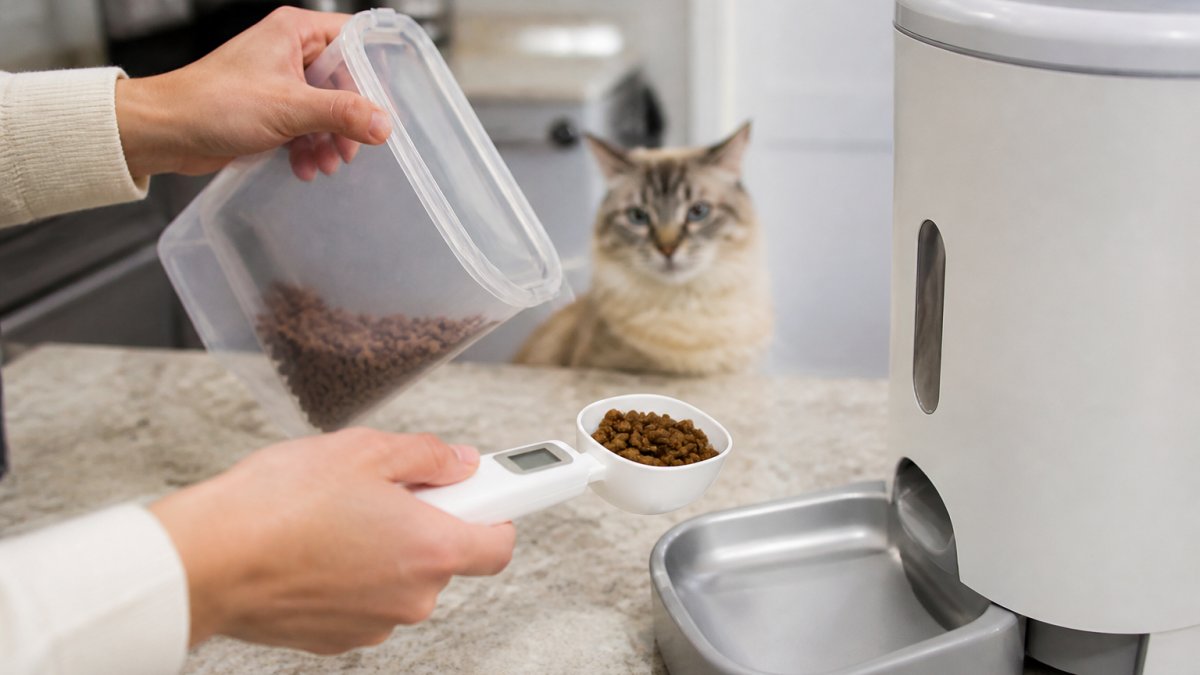
Start with these five checks:
- Serving increment: Can it dispense small portions, or only large ones?
- Kibble compatibility: Does the mechanism handle your food's shape and size?
- Hopper capacity: Does it hold enough for your feeding frequency?
- Power backup: What happens during an outage?
- App control: Do you need remote feeding, or is a simple timer enough?
Kibble Compatibility and Dispensing Reliability
Dispensing reliability is the criterion buyers underestimate most. A feeder's auger or rotating mechanism is tuned for a range of kibble sizes, and food outside that range causes jams or over-dispensing. Very small kibble can slip through in uneven amounts; very large or irregular pieces can clog the chute. Watch out: buying a feeder before checking your food's kibble size against the manufacturer's supported range is a common source of problems.
Meal Scheduling, Feeding Frequency, and Food Capacity
Scheduling flexibility determines how well a feeder fits your cat's routine. Most programmable feeders let you set multiple meals per day, which suits cats that do better with smaller, more frequent servings. The trade-off is capacity: more meals per day means the hopper empties faster.
For cats on weight management plans, small portions and frequent meals are often paired deliberately. Confirm the feeder's minimum increment supports the plan your veterinarian set before you commit.
Automatic Cat Feeder for Multiple Cats: Access Control and Household Logistics
An automatic cat feeder for multiple cats needs more than extra capacity. In a multi-pet household, the real problem is access: one cat finishes their portion and moves to the next bowl. Portion control collapses the moment a faster cat can eat from a second station, and the cat on the weight plan is the one who loses.
There are three workable setups, and the right one depends on whether your cats have access conflicts:
- Separate scheduled feeders, placed apart. The simplest option. Each cat gets its own feeder in a different room or on a different floor, so a cat that finishes early has to travel to poach. This works when cats are roughly evenly matched and don't patrol. Watch out: placing two feeders side by side defeats the purpose, because the faster cat simply guards both.
- Microchip or RFID access feeders. These open only for the registered cat, which keeps portions assigned to the right animal. Each cat needs registration and testing, and the feeder needs a clear read of the microchip or collar tag at the bowl. Setup complexity is the trade-off, along with cost.
- A single feeder plus scheduled human-supervised meals. For households where cats eat at different speeds, a feeder handles the routine meals and a person handles the contested ones. This is the lowest-tech option and often the most reliable.
Registration and Testing for Microchip Feeders
Microchip feeders only work if the reader reliably identifies each cat. Test the registration before you trust it:
- Register each cat's microchip or collar tag in the feeder's app or on-unit menu, following the manual's order.
- Watch a full meal cycle for each cat and confirm the lid opens for the right animal and stays closed for the others.
- Test the edge cases: a cat approaching from the side, two cats approaching at once, and a cat wearing a collar tag that has shifted position.
- Re-test after any collar change or tag replacement.
A common pattern is a feeder that reads one cat reliably but hesitates on a second cat with a chip implanted slightly off-center. If a cat is consistently misread, a vet can confirm the chip's location and read range.
Household Logistics Beyond the Bowl
Multi-cat feeding is a household logistics problem as much as a hardware problem. Water stations should be separate from food stations and placed away from each other, since cats often avoid eating next to a water source.
For households with three or more cats, the practical limit is usually the number of microchip feeders you're willing to buy and maintain. Each unit needs its own power source, its own cleaning schedule, and its own registration testing.
Digital Pet Food Measuring Spoon →
Automatic Cat Feeder for Wet Food: What Actually Works
An automatic cat feeder for wet food works differently from a dry-food dispenser, and the difference is mechanical. Wet food doesn't flow through hoppers or augers; it spoils when left at room temperature. Feeders designed for wet food typically use sealed compartments that rotate open at set times, often with ice packs or cooling elements to hold food fresh for a limited window. These work for short absences, not week-long trips.
Automatic Cat Feeder With Refrigerated Wet Food: Cooling, Cost, and Trade-offs
An automatic cat feeder with refrigerated wet food adds active cooling to the compartment design, extending how long wet food stays safe before a scheduled opening. These units cost more, draw power continuously, and depend on a reliable supply, so battery backup matters more than on a simple dry feeder. The honest trade-off: refrigeration buys you time, not indefinite storage. For most households, a cooled compartment feeder covers a long workday or an overnight trip.
Calibrating Portions and Planning for Failures
Calibration is the step almost everyone skips, and it's the one that makes portion control real.
The fix is a repeatable weigh-and-adjust loop, run before you trust the feeder unattended:
- Zero a kitchen scale that reads in 1-gram increments. A digital pet food measuring spoon can work for this; the digital pet food measuring spoon from Fluff Mart measures in 1-gram increments up to 800 grams.
- Run five consecutive test cycles at the setting you plan to use, catching each portion in a separate bowl or tare cup.
- Weigh each cycle and write down the numbers. You are looking for two things: the average (does it match your target?) and the spread (does the same setting deliver the same weight every time?).
- Adjust the program until the average hits your target, then run five more cycles to confirm the spread is tight.
- Re-calibrate after every food switch, hopper refill habit change, or firmware update. Kibble that has sat in the hopper and absorbed humidity dispenses differently than fresh food.
A common pattern is a spread of several grams between cycles on auger-style feeders, with the widest variation on the first cycle after a refill.

Watch out: calibrating with a different kibble than the one you'll actually feed produces numbers that don't transfer. Calibrate with the food in the hopper.
Minimum Dispense Increments and Very Small Portions
Portion control matters most for cats on tiny servings, medication-adjacent routines, or many-small-meals schedules. Most programmable dry feeders dispense in fixed increments, often described as "portion units" rather than cups or grams, and the smallest unit varies widely between models.
For cats that need many small meals, capacity becomes the constraint. A hopper sized for two meals a day may only last a few days on a six-meal schedule, so match hopper size to frequency rather than to the biggest number on the box.
Planning for Power, Wi-Fi, and Jam Failures
Every automatic feeder will eventually miss a meal. The question is whether you find out in time. Build a failure plan before the first unattended use:
- Test battery backup by unplugging the unit mid-schedule and confirming the next meal still dispenses. Batteries that have never been load-tested are a guess, not a backup.
- Confirm the low-food alert works by letting the hopper run down on a day you're home.
- Confirm the jam alert works by triggering it deliberately, if the manual describes how, or by watching for the alert during the first week of normal use.
- Keep a manual feeding plan for outages: pre-measured portions in labeled containers, plus a neighbor or sitter who knows the schedule.
- Check the chute weekly for buildup and re-test the first cycle after any cleaning.
Watch out: a Wi-Fi-connected feeder that loses its connection may keep running its stored schedule or may not, depending on the model.
An unattended feeder is not a substitute for a pet sitter on long trips. Use it for workdays, overnight absences, and routine consistency, and keep a human in the loop for anything longer.
The calibration loop is simple, but it only works if you run every step in order.
| Step | What to do | Note |
|---|---|---|
| 1 | Zero a kitchen scale reading in 1-gram increments | Fluff Mart spoon measures up to 800 grams |
| 2 | Run five consecutive test cycles at your planned setting | Catch each portion separately |
| 3 | Weigh each cycle and write down the numbers | Check the average and the spread |
| 4 | Adjust the program until the average hits target | Run five more cycles to confirm spread |
| 5 | Re-calibrate after food switch, refill habit change, or firmware update | Kibble that absorbed humidity dispenses differently |
Setting Up Your Precision Feeding Routine With Fluff Mart
Getting portion control right comes down to matching the feeder to your cat's kibble, schedule, and household, then calibrating until the numbers hold. Fluff Mart offers precision feeding tools, backed by a 30-day money-back guarantee and worldwide shipping. Get started with Fluff Mart and turn feeding from a daily guess into a repeatable routine you can trust.
Frequently Asked Questions
How accurately do automatic cat feeders measure portions?
Accuracy varies by model and by the kibble you use. Most feeders measure by volume or dispense time rather than weight, so a portion labeled as one cup can drift when kibble size or shape changes. Check the smallest portion increment the feeder allows, then weigh a few dispensed portions on a kitchen scale for the first week. A digital pet food measuring spoon that reads in 1-gram increments can help you weigh what the feeder is actually delivering.
Can an automatic cat feeder dispense very small portions?
Many can, but the minimum increment matters more than the maximum. Feeders that dispense in small steps let you split meals into several small servings across the day, which suits cats that eat too fast or need frequent small meals. Before buying, look for the smallest portion the feeder can reliably drop and confirm it with your own kibble. If a feeder's minimum is too large, portion control becomes guesswork.
Is an automatic cat feeder for multiple cats a good fit for my household?
It can be, but only if the feeder handles access. In a multi-cat home, one cat often eats more than its share, so look for microchip or RFID access that opens only for a registered cat. Without access control, a single feeder mostly benefits the fastest eater. Pair access-controlled feeding with a separate feeding station per cat and weigh each cat regularly to confirm the portions are landing where you intend.
Do automatic cat feeders work with wet food?
Most standard feeders are built for dry kibble and jam with wet food. Wet food feeders use sealed compartments, rotating trays, or cooling elements instead of a hopper. If you feed wet food, decide how long the food can safely sit out and choose a feeder that matches that window. Refrigerated models cost more and need a power supply, so weigh the convenience against the price before committing.
