

Last Updated: November 7, 2026
Quick Summary
The best automatic dog feeder for large breeds has a large-capacity hopper, a wide chute that handles large kibble, accurate portion control, a weighted base, and a locking lid. Size up to a 20-pound hopper to double refill intervals, and test dispensing with your dog's actual kibble before trusting it with dinner.
- A 10-pound hopper holds roughly 40 cups, lasting a 70-pound dog about 13 days at 3 cups daily.
- Large-breed kibble commonly runs 12 to 18 mm across, so a wide dispensing opening prevents bridging at the chute.
- Weigh dispensed portions on a kitchen scale to confirm the feeder delivers what it promises.
- Two large dogs need separate feeders spaced apart to prevent food guarding and uneven portions.
- Choose dual power with battery backup so a power outage does not mean a missed meal.
Table of Contents
- What Large-Breed Owners Should Look for in an Automatic Dog Feeder
- Why a Large-Capacity Automatic Dog Feeder Saves You Refill Trips
- Kibble Size, Anti-Clog Design and Dispensing Reliability
- Getting Portions Right With an Automatic Dog Feeder With Portion Control
- Running an Automatic Dog Feeder for Two Large Dogs
- What Makes a Reliable Automatic Pet Feeder for Big Appetites
- Frequently Asked Questions
What Large-Breed Owners Should Look for in an Automatic Dog Feeder
Finding the best automatic dog feeder for large breeds comes down to a short list of specs that separate a feeder built for big appetites from one designed for a toy poodle. The right unit needs a hopper that holds several days of food, a dispensing mechanism that handles wide kibble, and a base heavy enough that a determined Labrador cannot tip it over.
Large-dog owners often ask whether a feeder will jam, hold enough food, or be outsmarted by a clever dog. Below, we break down exactly how to judge an automatic dog feeder before you buy, including the portion accuracy, capacity math, and security features that matter most for big dogs.
Size is the first filter. A feeder sized for small breeds can run out of food quickly in a household with large dogs. According to the Association for Pet Obesity Prevention, portion control is one of the most effective tools owners have for managing a dog's weight, which makes accurate dispensing a health feature, not a luxury.
Here is the short version of what to check:
| Feature | Why It Matters for Large Breeds | What to Look For |
|---|---|---|
| Food capacity | Fewer refill trips | Hopper sized to your dogs' daily intake |
| Kibble compatibility | Prevents jams | Wide chute for large kibble |
| Portion accuracy | Weight management | Measured increments, verifiable |
| Base stability | Stops tipping | Wide, weighted base |
| Lid security | Stops raids | Locking lid |
| Power backup | Meals during outages | Dual power or battery backup |
Why a Large-Capacity Automatic Dog Feeder Saves You Refill Trips
A large-capacity automatic dog feeder is worth the extra footprint because it turns daily scooping into a weekly task. The math is simple: a big dog eating several cups a day drains a small hopper fast.
Most listings advertise capacity in liters or pounds, which tells you nothing about how long the food lasts. Convert it yourself. One standard 8-ounce measuring cup of dry kibble weighs roughly 3.5 to 4.5 ounces depending on the formula and kibble density, so a 10-pound hopper holds somewhere around 35 to 45 cups.
Then divide by your dog's daily intake. A 70-pound dog eating 3 cups a day gets about 13 days from a 10-pound hopper; a 100-pound dog eating 4.5 cups a day gets about 9 days from the same feeder. Two large dogs eating 7.5 cups combined drop that to roughly 5 days.
| Hopper capacity | ~Cups (at 4 oz/cup) | 70-lb dog, 3 cups/day | 100-lb dog, 4.5 cups/day | Two large dogs, 7.5 cups/day |
|---|---|---|---|---|
| 10 lb | ~40 | ~13 days | ~9 days | ~5 days |
| 20 lb | ~80 | ~27 days | ~18 days | ~11 days |
| 30 lb | ~120 | ~40 days | ~27 days | ~16 days |
These are planning estimates, not guarantees. Kibble weight per cup varies by brand, so weigh a cup of your dog's food on a kitchen scale once and use that number.
Capacity also affects freshness. A sealed, locking lid keeps kibble dry and keeps food-motivated dogs out between meals. Watch out: an oversized hopper with a weak lid is an open invitation for a clever dog to help itself, and a hopper that sits half-full for weeks can go stale before it is eaten.
Days a hopper lasts by capacity and dog size
Kibble Size, Anti-Clog Design and Dispensing Reliability
Dispensing reliability is where budget feeders fail large breeds most often. Wide kibble and high-volume feeding put more stress on the mechanism, so an anti-clog design and a chute sized for large kibble matter more than any app feature. A food jam at dinner time is worse than no feeder at all.
What most guides miss is that clogging usually starts at the chute, not the hopper. Large-breed kibble commonly runs 12 to 18 mm across, and a chute sized for small-breed food will bridge at that width.
To judge a feeder before you trust it with dinner, run a simple home test. Load the hopper with your dog's actual kibble, program three full-size meals, and watch each dispense. Then repeat for a full week and note any partial drops, double drops, or stalls.
| Test | What to do | What a pass looks like |
|---|---|---|
| Large-kibble drop | Dispense 3 full meals with your kibble | Every portion lands in the tray, no bridging at the chute |
| Low-hopper test | Run the hopper down to about one-third full | Dispensing stays consistent as food level drops |
| Repeat-meal test | Program a full week of meals | No partial drops, double drops, or stalls |
| Tray overflow | Serve your dog's largest single meal | Food stays in the tray, not on the floor |
Watch out: a feeder that passes on day one can still jam once kibble dust builds up in the chute, so clean the dispensing path on the schedule the manufacturer specifies and re-test after cleaning.
If your dog is a picky eater or a fast scrambler, reliability becomes even more important. Our guide to the best automatic feeders for picky eaters in 2026 compares options built around consistent dispensing.
Getting Portions Right With an Automatic Dog Feeder With Portion Control
An automatic dog feeder with portion control is the feature that pays off in health, not just convenience. Accurate, repeatable meal portions help you follow your vet's feeding plan and manage daily food intake, which matters most for large breeds prone to weight gain.
Programmable feeding lets you set meal frequency and portion size, then trust the schedule. But verify accuracy yourself: weigh a few dispensed portions on a kitchen scale to confirm the feeder delivers what it promises. This is where a simple tool earns its place.
To check portions by hand, the digital pet food measuring spoon weighs up to 800 g in 1 g increments, so you can confirm serving sizes against your dog's plan. For a deeper look at portion settings, our article on how to pick an automatic cat feeder with portion control covers the same mechanics.

Running an Automatic Dog Feeder for Two Large Dogs
An automatic dog feeder for two large dogs needs more than double the capacity of a single-dog setup. Multi-pet households face food guarding, uneven portions, and one dog finishing before the other even starts. Plan for separate feeding stations or a feeder with split bowls and clear scheduling.
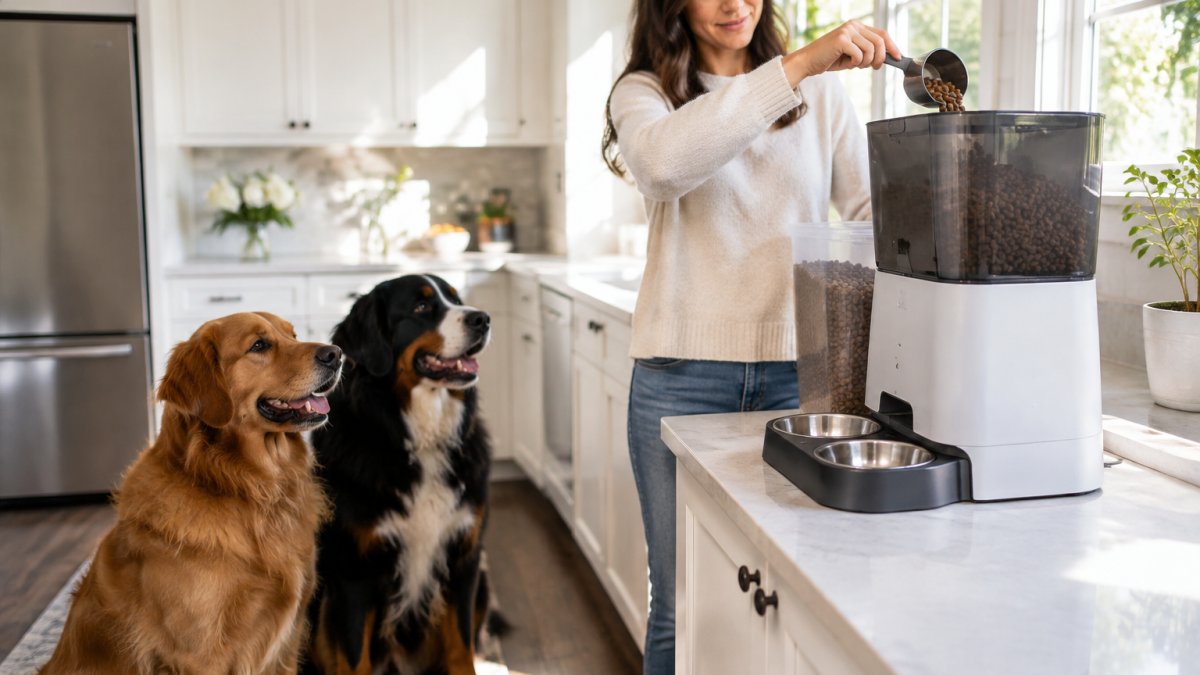
A common mistake is expecting one feeder to manage two big dogs fairly. If one dog is food-motivated and the other is slow, the fast eater will clean both bowls. Separate feeders, spaced apart, reduce guarding and keep portions honest.
What Makes a Reliable Automatic Pet Feeder for Big Appetites
A reliable automatic pet feeder for big appetites combines durable construction, a stable base, and power backup that keeps meals on schedule. Large dogs lean, nudge, and sometimes test the equipment, so build quality is not a detail you can skip.
Look for tipping resistance, a locking lid, and dual power with battery backup so a power outage does not mean a missed meal. Easy-to-clean parts matter too, since food residue builds up fast in high-volume feeding.
Weighing whether a high-tech feeder is worth the investment? Our breakdown of whether high-tech dog gadgets are worth the money helps you decide. And before you buy, the Fluff Mart FAQ answers questions on shipping, returns, and product care.
Choosing the right feeder for a big dog takes a little math and a clear checklist, and getting it right means calmer mornings and healthier meals. If you want a precision tool to verify every portion, Fluff Mart carries feeding solutions tested for safety and backed by a 30-day money-back guarantee. Get started with Fluff Mart and make every meal count.
Frequently Asked Questions
What should I look for in an automatic dog feeder for large breeds?
Start with food capacity, since a large breed can eat 3 to 6 cups a day and a small hopper means constant refills. Check the kibble size the dispensing mechanism accepts, because large kibble jams narrow chutes. Look for a wide food tray, a stable non-tipping base, and portion settings that reach the cup sizes your dog actually eats. A locking lid and battery backup matter too if your dog is food-motivated or you travel.
Can one automatic dog feeder feed two large dogs?
It can, but only if the feeder supports multiple feeding stations or your dogs eat from a shared bowl without guarding. Most single-outlet units drop all the food in one tray, which favors the faster or more dominant dog. For an automatic dog feeder for two large dogs, look for split-bowl designs, dual hoppers, or a model that lets you set separate schedules. Watch the first few meals to confirm each dog gets its share.
How much food can an automatic dog feeder hold?
Capacity varies widely, from a few cups in compact models to 20 cups or more in large-capacity units. To translate capacity into days, divide the hopper volume by your dog's daily intake. A 100-pound dog eating 5 cups a day drains a 20-cup hopper in about four days. If you travel or work long shifts, choose a feeder that covers your longest stretch away plus a buffer.
Do vets recommend automatic feeders?
Automatic feeders can help keep meal times consistent and portions measured, which may support weight management. They also flag limits: unattended feeding means you are not watching for choking, food guarding, or a jammed dispenser, and a feeder cannot replace fresh water or monitoring. Ask your vet for a daily calorie target first, then set the feeder to match it rather than guessing at portion sizes.
