

Quick Summary
The best automatic feeders for picky eaters are ones with precise, adjustable portion control, battery backup and a shallow bowl that suits a wary cat. Grazing cats often do best on several small scheduled meals, which these feeders can release. Check kibble size compatibility and jam resistance before you buy.
- Grazing cats often need several small meals, which scheduled portions suit well.
- Confirm the feeder's portion range, because some offer only two or three fixed settings.
- Battery backup keeps a fussy cat's schedule intact during a power outage.
- Shallow, wide bowls can reduce whisker fatigue and encourage hesitant cats to eat.
- Introduce the feeder beside the usual bowl, changing one thing at a time.
Table of Contents
- Why Picky Eaters Need a Different Kind of Feeder
- Key Features to Look for in an Automatic Feeder
- Best Automatic Cat Feeder for Wet Food
- What Is the Most Reliable Automatic Pet Feeder?
- How to Get a Picky Cat to Use an Automatic Feeder
- Cleaning, Maintenance and Long-Term Durability
- Choosing Your Feeder and Setting Up a Trial at Home
- Frequently Asked Questions
Why Picky Eaters Need a Different Kind of Feeder
A cat that picks at its food is not always being difficult. Many fussy eaters prefer to graze, eating small amounts across the day instead of finishing a full bowl at once. A standard bowl left out all day can lead to stale food, uneaten portions, and inconsistent intake that is hard to track.
How grazing and fussy eating change feeding routines
Grazing cats often need several small meals rather than two large ones. An automatic feeder set to release small portions at set times fits that pattern well. It also lets you see at a glance whether the scheduled portions are being eaten, which helps you spot a drop in appetite early.
Key Features to Look for in an Automatic Feeder
Not every automatic feeder suits a picky eater. The right choice depends on how accurately it dispenses, how much it holds, and how easily it fits your routine. The features below are the ones that separate a feeder a fussy cat will actually eat from one that ends up in a closet.
Portion control and dispensing accuracy
Portion control matters most for cats that need consistent calorie intake. Look for a feeder with adjustable portion sizes and a dispensing mechanism that releases the same amount each time. A feeder that clogs or drops irregular portions makes it hard to tell what your cat actually ate.
Dispensing accuracy depends on mechanism type. The three common designs behave differently with a picky eater:
- Auger (screw) dispensers turn a rotating screw to push kibble out. They are the most precise at small portion sizes, which matters when you are releasing a quarter-ounce at a time to tempt a grazer, but they are the most prone to jamming on irregular or oversized kibble.
- Gravity-and-gate dispensers drop food through a sliding gate. They handle a wider range of kibble shapes and sizes, but portion accuracy drifts as the hopper empties because the weight of the food above the gate changes.
- Rotating-drum or carousel dispensers meter food from sealed compartments. They are the most consistent portion to portion and the easiest to clean, but capacity is usually lower and the compartments limit how small a portion you can set.
Most feeders advertise portion sizes in "cups" or "meals," but the actual gram weight per portion varies by food density. Weigh a few dispensed portions on a kitchen scale before you trust the label. A feeder that claims a quarter-cup portion may deliver noticeably more or less depending on whether you use a dense kibble or a light, airy one.
Watch out: a feeder with only two or three fixed portion settings cannot be tuned to a picky cat that eats a small amount at a time, so confirm the portion range before buying.
Hopper capacity, power source and smart programming
Hopper size determines how many days the feeder can run unattended, so match it to your schedule. A typical hopper holds between 3 and 6 pounds of kibble, which works out to roughly one to three weeks for a single cat eating a quarter to a half cup per day.
Power source is where cheap feeders fail. Most run on either batteries alone, an AC adapter alone, or an AC adapter with battery backup. For a picky eater, battery backup is not optional: a missed meal during an outage can push a fussy cat off its schedule for days.
Smart programming through a mobile app is useful for one specific reason with picky eaters: you can adjust portion size and timing remotely when you see food going uneaten, without reprogramming at the unit.
Bowl shape and sensory features
This is the feature most buying guides skip, and it is the one that matters most for a picky eater. Cats are sensitive to whisker fatigue, the irritation some cats feel when their whiskers brush the sides of a deep bowl. A shallow, wide bowl or a plate-style insert reduces that contact and can make a hesitant cat more willing to eat from the feeder.
Some feeders include a voice-recording feature that plays your voice at mealtime. For a cat that is wary of the machine, a familiar voice can speed acclimation, but the recording also draws the cat to the feeder at the wrong times if it plays on every dispense. Slow-feed inserts and maze bowls are another option: they slow a cat that bolts its food, but they can frustrate a picky eater that already eats reluctantly, so treat them as a tool for the right cat rather than a default.
Food size and texture compatibility
Kibble size is the most common cause of jams. Most auger feeders are rated for kibble up to roughly 0.4 inch in diameter; larger or irregular pieces, freeze-dried chunks, and kibble with a lot of powder or dust will clog the screw. If your cat eats a prescription diet or a freeze-dried raw topper, check the manufacturer's stated kibble size range and whether the feeder is rated for anything other than uniform dry kibble. Very few automatic feeders handle wet food, and those that do use sealed, cooled compartments that need cleaning after every use.
The three common dispenser designs behave differently with a picky eater, as summarised below.
| Mechanism | Strength | Watch-out |
|---|---|---|
| Auger (screw) | Most precise at small portions | Prone to jamming on irregular kibble |
| Gravity-and-gate | Handles wider kibble range | Portion accuracy drifts as hopper empties |
| Rotating drum or carousel | Most consistent portion to portion | Lower capacity and limited minimum portion |
Best Automatic Cat Feeder for Wet Food
Most automatic feeders are designed for dry kibble. Wet food spoils faster, sticks to mechanisms, and needs a cooled or sealed compartment, so a feeder rated for wet food is worth checking before you buy. If your cat eats wet food, confirm the model's food-handling limits and clean the compartment after each use.
What Is the Most Reliable Automatic Pet Feeder?
Reliability comes from a jam-resistant mechanism, a sturdy hopper, and a clear power backup. A reliable feeder should dispense the same portion day after day without intervention. Read owner reviews for reports of clogging or timing errors, since these problems show up quickly in daily use.
Most reviews stop at the unboxing. For a picky eater, the question that matters is what the feeder does at month six, when the novelty has worn off and a missed meal sends the cat back to refusing the machine. The failure patterns below are the ones that show up most often in long-term owner reports, and they are worth checking before you buy.
Common mechanical failure points
- The auger and food chute. Fine dust and crumbs from kibble build up on the screw and in the chute, and over weeks they harden into a crust that slows or stops dispensing. Feeders with removable, dishwasher-safe chutes and augers are far easier to keep running than sealed units you can only wipe down.
- The lid seal and hopper gasket. A worn gasket lets humidity in, and stale or soft kibble is exactly what a picky cat refuses. Silicone gaskets last longer than foam ones; check whether replacements are sold separately.
- The battery contacts. Battery corrosion is a quiet killer. Feeders that use spring contacts in an open compartment corrode faster in humid kitchens than models with sealed battery bays.
- The motor and gearbox. Cheaper feeders use plastic gears that strip after repeated jams. A feeder that jams once and strips a gear is done; a feeder with a slip clutch or jam-recovery routine will reverse and retry instead.
- The clock and schedule memory. Some units lose time after a power blip and drift by minutes per day, which throws off a picky cat's routine. Look for a feeder that resyncs its clock automatically or holds time through battery backup.
What long-term owners report
A common pattern in owner reviews after six to twelve months is that the feeder still dispenses but the portion size has drifted, usually because the hopper is low or the chute is partially blocked. Weigh a portion once a month to catch drift before it affects your cat's intake. Another pattern is that app-connected feeders lose support when a manufacturer discontinues the app, which can leave the unit usable only through its physical buttons, if it has them.
Watch out: a feeder with no physical controls and an app that is no longer updated can become unusable even though the hardware still works, so confirm the unit has on-device programming before relying on the app.
How to judge reliability before you buy
Read reviews sorted by newest rather than most helpful, and look specifically for reports from owners past the three-month mark. Search the review text for the words "jam," "stuck," "reset," and "battery" to surface the failure reports quickly. Check whether the manufacturer sells replacement augers, gaskets, and bowls, because a feeder with available parts is a feeder you can keep running for years. Finally, confirm the warranty length and what it covers: a one-year warranty that excludes the motor tells you where the manufacturer expects failures.
How to Get a Picky Cat to Use an Automatic Feeder
Many cats are wary of a new machine. Start by placing the feeder beside the bowl you already use, so your cat associates it with the food it knows. If your cat also eats too fast, these mealtime fixes that complement an automatic feeder setup can help. Run it with a small amount of a favorite treat first, then gradually switch to regular portions. Most cats adjust within a week or two, though some take longer.
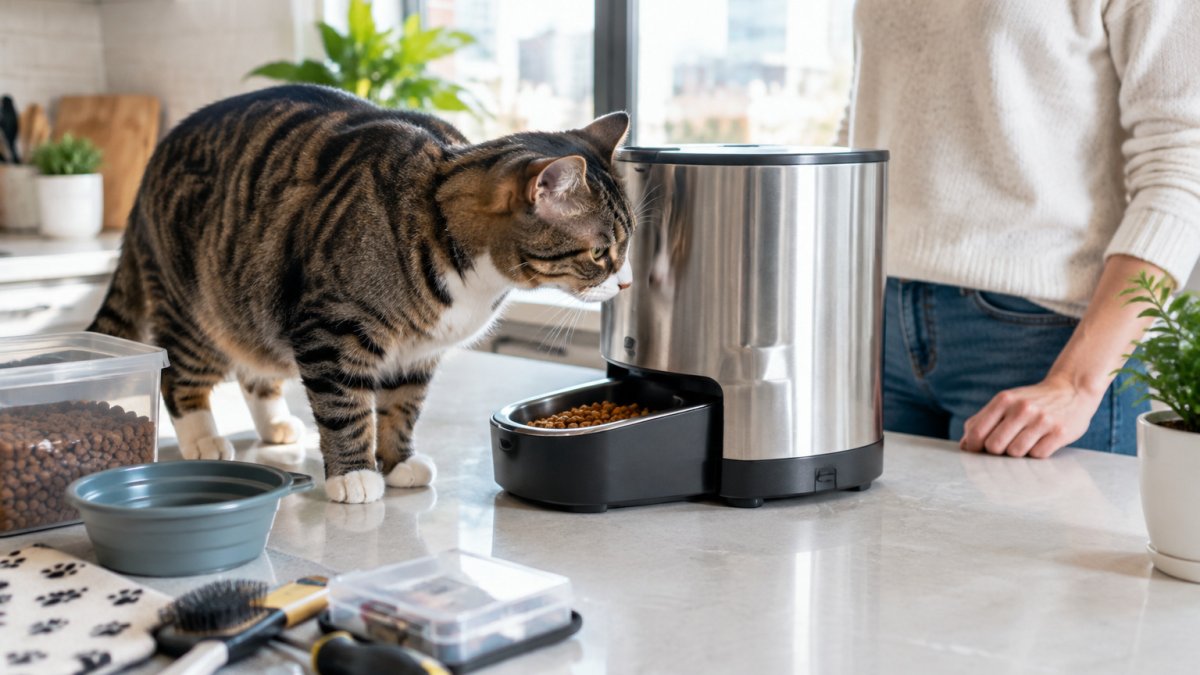
A common mistake is changing the food and the feeder at the same time. Introduce one change at a time so you can tell which one is causing a problem.
Cleaning, Maintenance and Long-Term Durability
A feeder that is not cleaned regularly can develop residue that affects dispensing and hygiene. To keep the cat's space fresh alongside feeding, consider a pet odor eliminator for litter boxes. Wipe the hopper and bowl after each refill and check the mechanism for crumbs. Look for stainless steel or BPA-free plastic components that stand up to repeated washing.

Choosing Your Feeder and Setting Up a Trial at Home
Start by listing your cat's feeding pattern, how much food it needs per day, and whether you use wet or dry food. Then compare feeders against those needs rather than against feature counts. Run a trial for a week, track how much your cat eats, and adjust the schedule before committing to a long-term setup.
For current prices and availability, visit the Fluff Mart website or contact our team for a quote based on your cat's routine.
Frequently Asked Questions
Do vets recommend automatic feeders?
Many veterinarians see automatic feeders as a useful tool for meal timing and portion control, especially for pets that need measured meals or that are prone to overeating. They are not a replacement for a feeding plan set with your vet. Ask your veterinarian whether scheduled, measured meals suit your pet's weight, health history and diet, and review any feeder settings with them before you rely on one for a medical diet.
Can I leave my cat alone for 4 days with an automatic feeder?
Automatic feeders are designed for short absences, but four days is a long time to rely on any device alone. Check that the hopper capacity covers the full period, that the food stays fresh in the bowl, and that the feeder has a backup power option. Arrange for someone to check water, litter and the feeder itself, since a jam or empty hopper can go unnoticed for days.
Can an automatic feeder keep wet food fresh?
Most standard automatic feeders are built for dry kibble, so wet food can spoil quickly in a warm room. Look for models with a refrigerated or cooled compartment if you plan to use wet food, and avoid leaving open wet food in an uncooled hopper for more than a few hours. Wash the bowl and tray thoroughly after each use.
Are automatic feeders worth it for picky eaters?
They can be, when the feeder's portion control and scheduling match your pet's routine. A picky eater that grazes may do better with several small, timed portions than one large bowl. Test the feeder for a few days with your pet's usual food before relying on it. Fluff Mart can help you compare feeder options, and current pricing depends on the model, quantity and delivery, so check the Fluff Mart website for a quote.
